
← Back to Articles
Article
The Future Impact of Directed Energy Weapons on Warfare: From Science Fiction to a New Layer of Air Defence
By Maj Gen Rajan Kochhar, VSM, (Retd.)
September 21, 2026

The Future Impact of Directed Energy Weapons on Warfare: From Science Fiction to a New Layer of Air Defence
Directed Energy Weapons (DEWs) are moving from the realm of laboratory experimentation and technology demonstrators towards becoming an important component of modern warfare. The proliferation of drones, loitering munitions, precision-guided weapons and saturation attacks has created a particularly strong case for weapons that can engage targets at the speed of light and, in the case of lasers, with extremely low marginal cost per engagement.
The United States Department of Defense defines directed-energy weapons as systems using concentrated electromagnetic energy rather than kinetic energy to incapacitate, damage, disable or destroy equipment, facilities or personnel. The principal technologies today are High-Energy Lasers (HEL) and High-Power Microwaves (HPM).
The significance of DEWs lies not merely in their destructive power. Their real military value is the possibility of changing the economics, speed and depth of air defence. A drone costing a few thousand dollars should not ideally be defeated by a missile costing hundreds of thousands or millions of dollars. A laser potentially changes that equation.
The Technology Behind Directed Energy Weapons:
A high-energy laser converts electrical energy into a highly concentrated optical beam. The beam is directed and focused on a vulnerable portion of the target. Sustained energy deposition heats the target surface until its structure, propulsion system, control surfaces, electronics or other critical component fails.
Modern laser weapons therefore require much more than a powerful laser source. They require an entire technology ecosystem comprising power generation and storage, laser sources, beam control, precision tracking, adaptive optics, thermal management, target acquisition and battle-management systems.
The quality of the beam is particularly important. Atmospheric turbulence, dust, humidity, rain, smoke and other factors can distort or attenuate a laser beam. Adaptive-optics technology compensates for atmospheric distortion and allows the energy to remain concentrated on the target.
High-Power Microwave systems work differently. Instead of concentrating optical energy on the target, they generate intense electromagnetic radiation. Their principal attraction is their ability to affect electronic systems and potentially engage multiple electronics-dependent targets within an area. Consequently, the future DEW family should not be viewed simply as "laser weapons". It is more accurately a family of electromagnetic effects, ranging from electronic disruption to physical destruction.
The effectiveness of a laser-based Directed Energy Weapon is closely linked to its output power, beam quality, dwell time and atmospheric conditions, rather than power alone. Broadly, low-kilowatt systems (around 1–10 kW) are suitable primarily for small drones, sensors and other relatively fragile targets at short ranges; 20–50 kW-class systems provide greater range and destructive capacity against larger UAVs and more demanding targets; while 50–100 kW and above is the emerging class being pursued for more challenging aerial threats.
India has progressed from earlier 1–2 kW demonstrators to substantially higherpower systems: DRDO's 2025 IADWS included a high-power laser DEW, while public reporting on the indigenous programme has described 30-kW-class development and longer-term 50–100 kW ambitions. The important point, however, is that 100 kW of laser output does not mean 100 kW reaches the target; losses in the laser chain, beam director and atmosphere reduce delivered energy. Equally important are electrical-power generation, energy storage and thermal management: a weapon producing tens of kilowatts of optical power can require substantially more electrical input and must continuously dissipate waste heat. Consequently, a practical military DEW should be viewed as an integrated system of laser source + power supply + cooling + beam director + precision tracking + atmospheric compensation + command-and-control. India's future requirement should therefore move progressively from 10–30 kW systems for counter-UAS and close-in defence towards 50–100+ kW systems for more demanding targets, while retaining missiles and guns as complementary layers rather than attempting to make the laser a universal interceptor.
How Many Countries Are Developing or Using DEWs?
 There is no reliable single international figure for the number of countries "using" DEWs because the term encompasses experimental systems, prototypes, operational systems and research programmes.
However, a significant group of technologically advanced states has active programmes. The United States, Israel, China, United Kingdom, Russia, South Korea, India and Türkiye are among the countries publicly associated with serious DEW development or fielding efforts.
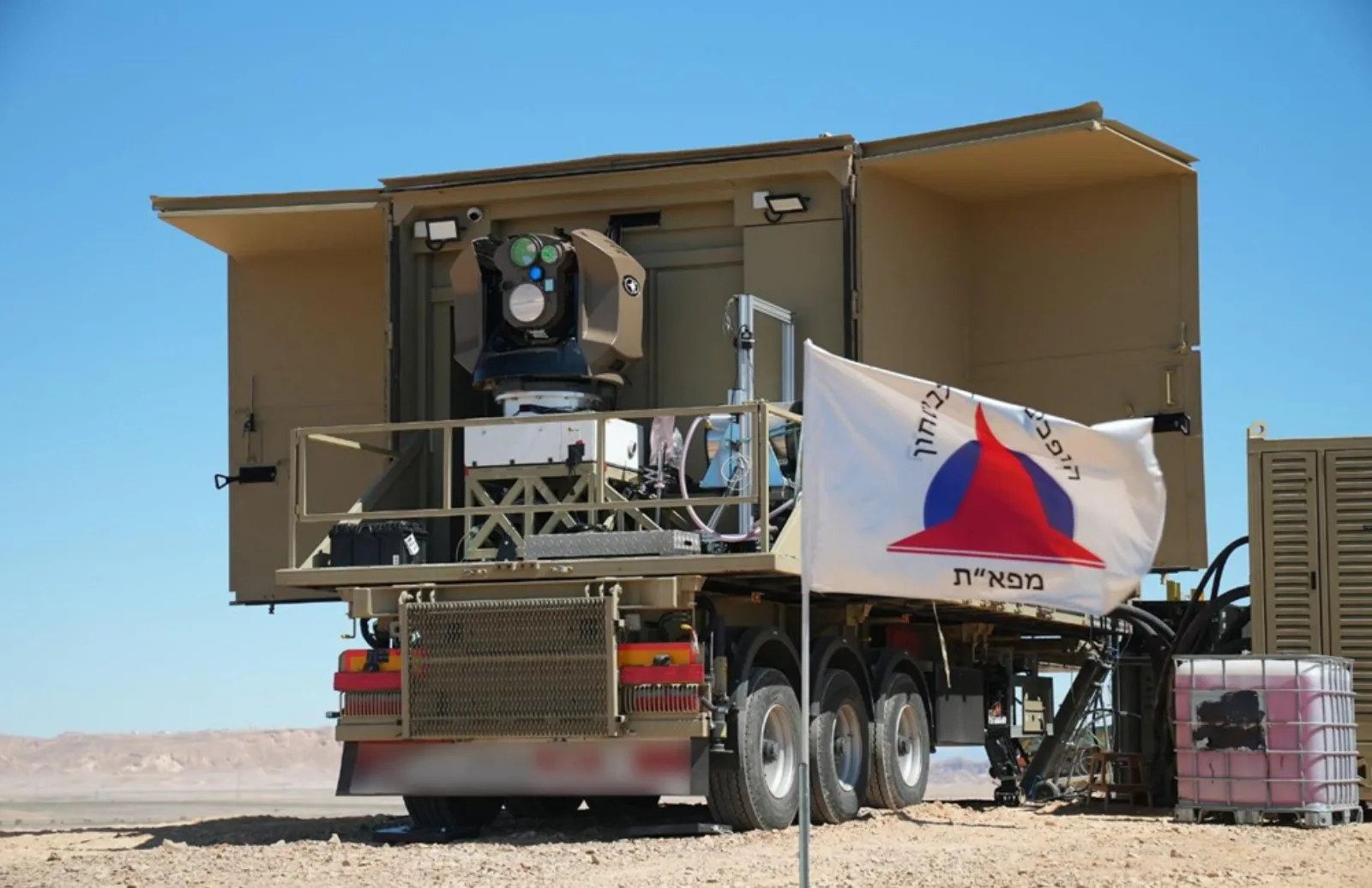
The distinction between development and operational deployment is important. Israel has moved furthest in publicly acknowledged operational high-energy laser air defence. In December 2025, Israel's Ministry of Defense announced delivery of the first operational Iron Beam system to the Israel Defense Forces. It stated that the system had demonstrated interceptions against rockets, mortars and UAVs and would complement Iron Dome, David's Sling and Arrow in Israel's multilayered air-defence architecture.
South Korea has also crossed the threshold towards operational deployment. Its DAPA describes the Laser Anti-Aircraft Weapon Block-I, developed primarily against small UAVs and multicopters, as having entered service in December 2024.
The United Kingdom is pursuing Dragon Fire. British trials have demonstrated the system against high-speed drones, and the government has contracted for Royal Navy installation, with deployment planned from 2027. The UK says the laser's cost per shot is approximately £10 compared with traditional missile interceptors costing hundreds of thousands of pounds or more.
The United States has conducted extensive experimentation with laser and microwave systems. In 2026, the US Army moved its Enduring High Energy Laser programme from prototype development towards production, describing it as its first production contract for a high-energy laser weapon system.
Türkiye is developing systems such as GÖKBERK, a mobile laser-based system intended to counter small UAVs and other close-range threats. Turkish testing has included FPV drones and autonomous tracking and engagement.
India is developing indigenous DEW capabilities through DRDO. Its laboratories have developed laser sources, electro-optical systems and DEWrelated technologies. DRDO's LASTEC, for example, has developed a 2-kilowatt continuous-wave high-power fibre laser.
More importantly, India has already demonstrated a high-power laser-based DEW as part of the Integrated Air Defence Weapon System (IADWS). In August 2025, DRDO conducted maiden flight tests of IADWS combining QRSAM, VSHORADS and a high-power laser-based DEW under a centralised command-and-control architecture.
Thus, the world is moving beyond asking whether DEWs are possible. The question increasingly is where they should sit within the force structure.
DEWs and the Revolution in Air Defence
There is no reliable single international figure for the number of countries "using" DEWs because the term encompasses experimental systems, prototypes, operational systems and research programmes.
However, a significant group of technologically advanced states has active programmes. The United States, Israel, China, United Kingdom, Russia, South Korea, India and Türkiye are among the countries publicly associated with serious DEW development or fielding efforts.
The distinction between development and operational deployment is important. Israel has moved furthest in publicly acknowledged operational high-energy laser air defence. In December 2025, Israel's Ministry of Defense announced delivery of the first operational Iron Beam system to the Israel Defense Forces. It stated that the system had demonstrated interceptions against rockets, mortars and UAVs and would complement Iron Dome, David's Sling and Arrow in Israel's multilayered air-defence architecture.
South Korea has also crossed the threshold towards operational deployment. Its DAPA describes the Laser Anti-Aircraft Weapon Block-I, developed primarily against small UAVs and multicopters, as having entered service in December 2024.
The United Kingdom is pursuing Dragon Fire. British trials have demonstrated the system against high-speed drones, and the government has contracted for Royal Navy installation, with deployment planned from 2027. The UK says the laser's cost per shot is approximately £10 compared with traditional missile interceptors costing hundreds of thousands of pounds or more.
The United States has conducted extensive experimentation with laser and microwave systems. In 2026, the US Army moved its Enduring High Energy Laser programme from prototype development towards production, describing it as its first production contract for a high-energy laser weapon system.
Türkiye is developing systems such as GÖKBERK, a mobile laser-based system intended to counter small UAVs and other close-range threats. Turkish testing has included FPV drones and autonomous tracking and engagement.
India is developing indigenous DEW capabilities through DRDO. Its laboratories have developed laser sources, electro-optical systems and DEWrelated technologies. DRDO's LASTEC, for example, has developed a 2-kilowatt continuous-wave high-power fibre laser.
More importantly, India has already demonstrated a high-power laser-based DEW as part of the Integrated Air Defence Weapon System (IADWS). In August 2025, DRDO conducted maiden flight tests of IADWS combining QRSAM, VSHORADS and a high-power laser-based DEW under a centralised command-and-control architecture.
Thus, the world is moving beyond asking whether DEWs are possible. The question increasingly is where they should sit within the force structure.
DEWs and the Revolution in Air Defence
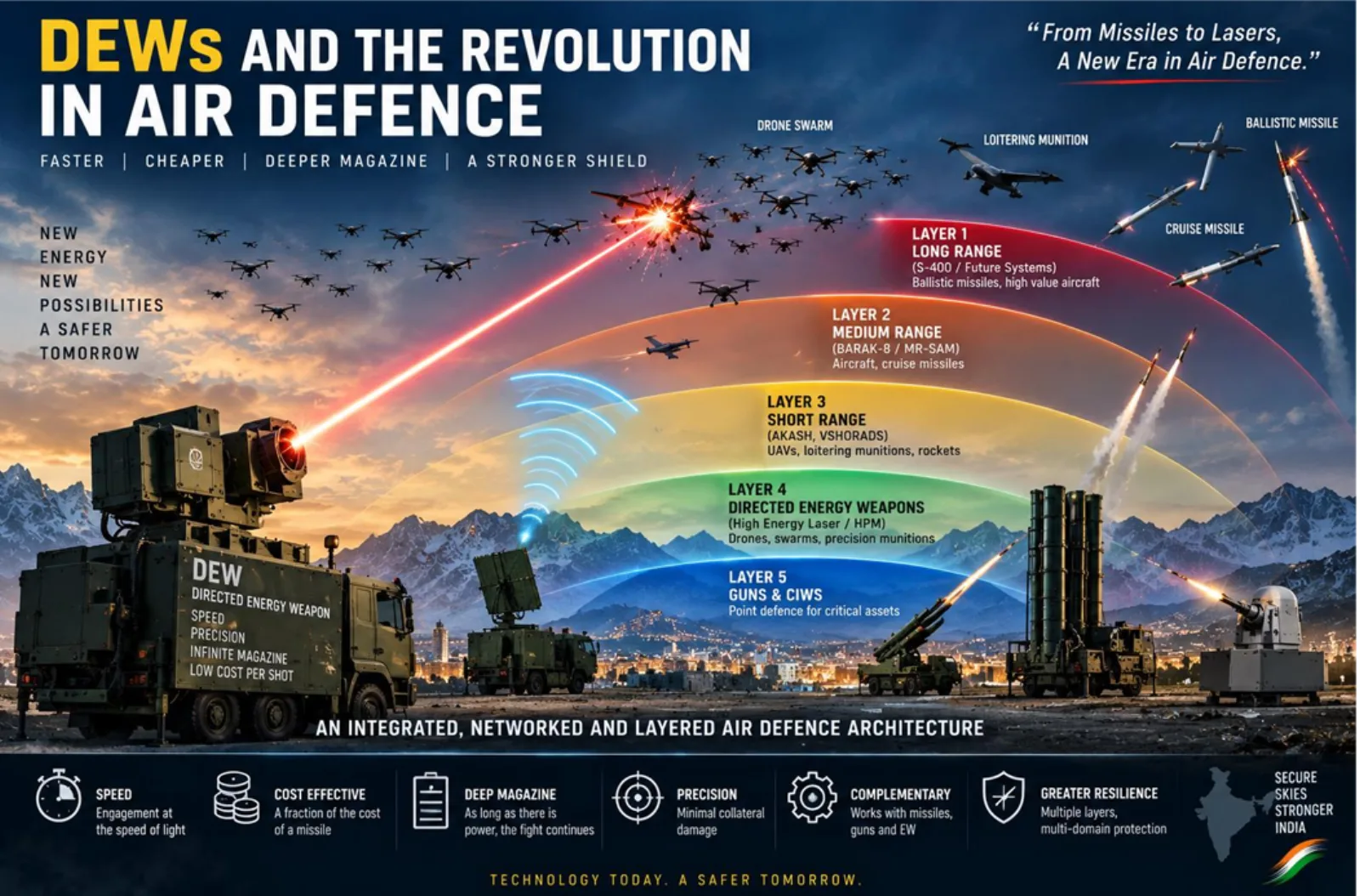 The most promising near-term application of DEWs is undoubtedly counterUAS and short-range air defence. The modern battlefield is increasingly saturated with inexpensive UAVs. Small drones can conduct reconnaissance, identify artillery targets, attack logistics nodes and deliver small munitions. Loitering munitions further blur the distinction between reconnaissance and attack.
A conventional air-defence system can defeat these threats, but sustained drone warfare can create a severe ammunition and cost problem. This is where DEWs become attractive. A missile has a finite magazine. A laser's "magazine" is effectively linked to its power generation and cooling capacity. Provided sufficient electrical power is available, the system can potentially conduct repeated engagements.
The US Army has already tested DE systems alongside conventional kinetic air defence against drone swarms. The Army explicitly describes DE and kinetic systems as complementary rather than mutually exclusive, with kinetic interceptors remaining necessary against targets that lasers cannot reliably defeat.
This is probably the correct model for the future. DEW will not replace missiles. It will become another layer.
The Future Air-Defence Architecture:
The most promising near-term application of DEWs is undoubtedly counterUAS and short-range air defence. The modern battlefield is increasingly saturated with inexpensive UAVs. Small drones can conduct reconnaissance, identify artillery targets, attack logistics nodes and deliver small munitions. Loitering munitions further blur the distinction between reconnaissance and attack.
A conventional air-defence system can defeat these threats, but sustained drone warfare can create a severe ammunition and cost problem. This is where DEWs become attractive. A missile has a finite magazine. A laser's "magazine" is effectively linked to its power generation and cooling capacity. Provided sufficient electrical power is available, the system can potentially conduct repeated engagements.
The US Army has already tested DE systems alongside conventional kinetic air defence against drone swarms. The Army explicitly describes DE and kinetic systems as complementary rather than mutually exclusive, with kinetic interceptors remaining necessary against targets that lasers cannot reliably defeat.
This is probably the correct model for the future. DEW will not replace missiles. It will become another layer.
The Future Air-Defence Architecture:
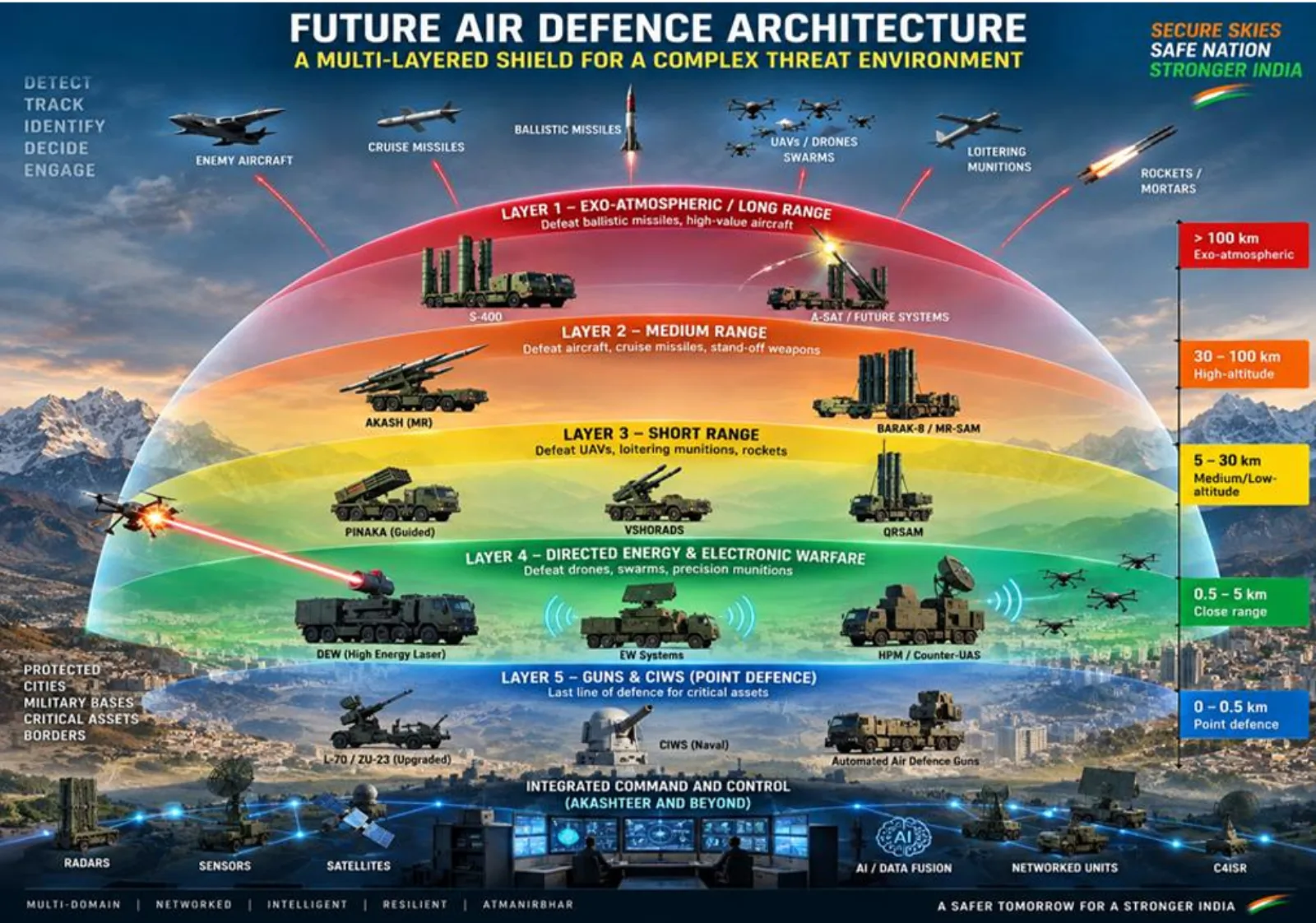 The air-defence system of the future could therefore resemble a layered pyramid. At the outer layer, long-range systems such as S-400-class systems and future indigenous long-range interceptors engage high-value aircraft and missiles.
The next layers comprise medium- and short-range surface-to-air missiles. Closer to the defended asset, guns, VSHORADS, electronic warfare and DEWs engage drones, cruise missiles and other low-altitude threats.
At the lowest-cost layer, electronic warfare can disrupt navigation, communications and control links. The DEW therefore becomes particularly valuable at the inner layer, where the number of relatively inexpensive threats may be very high. Israel's Iron Beam is perhaps the clearest illustration. Israel itself describes it as a complementary system alongside Iron Dome, David's Sling and Arrow rather than as a replacement for them. This is a crucial doctrinal lesson.
Reports around Prime Minister Modi's February 2026 Israel visit indicated that Iron Beam technology transfer/co-development was under discussion, potentially for integration into India's planned Mission Sudarshan Chakra.
However, neither the Indian nor Israeli government has publicly announced a confirmed contract specifically for procurement of Iron Beam batteries.
Why DEWs Are Particularly Relevant to Mountain Warfare
For India, the relevance becomes even greater when the problem is viewed through the lens of mountain warfare. The Himalayas impose extraordinary logistical constraints. Moving ammunition, fuel and replacement missiles to highaltitude positions is expensive and vulnerable to weather and terrain.
A DEW does not eliminate the requirement for logistics—it requires substantial electrical power, cooling and maintenance—but its ammunition burden can potentially be dramatically reduced.
Mountain warfare also creates numerous relatively fixed defended assets: command posts, logistics bases, radar stations, airfields, ammunition dumps and observation posts. A DEW positioned with an appropriate line of sight could provide a close-in protective layer against UAVs and loitering munitions. But the mountains also create a major disadvantage. A laser requires line of sight. A ridge, valley or intervening mountain can block the beam completely. Snow, fog, dust, rain and atmospheric turbulence can also degrade performance.
Therefore, India's Himalayan DEW architecture should not depend on one large system. It should use distributed, networked DEW nodes integrated with radars, electro-optical sensors and other air-defence weapons.
“In November 2020, reports emerged claiming that the PLA had employed a high-power microwave directed-energy weapon against Indian troops occupying heights in the Pangong Tso–Chushul sector. There is also no credible evidence that the PLA used a directed-energy weapon against Indian soldiers in Ladakh in 2020. The widely circulated story dates to November 2020, when a Chinese academic, Jin Canrong of Renmin University, claimed that PLA forces had used a “microwave weapon” against Indian troops occupying heights south of Pangong Tso around 29 August 2020. The claim said the microwave radiation caused soldiers to vomit and abandon the positions.
The Indian Army categorically rejected the claim, describing reports of microwave-weapon employment in eastern Ladakh as “baseless” and “fake.” PIB Fact Check likewise stated that no such incident had taken place.
What is Particularly Important:
The claim should therefore not be presented as an established example of DEW employment in combat. At most, it is an unverified allegation originating from a Chinese academic and reported by international media. There was no publicly available physical evidence, independent battlefield evidence, or official Chinese military confirmation establishing that such a weapon was actually employed against Indian troops. A later assessment by the Observer Research Foundation similarly described the story as having been widely regarded as psychological operations, while noting that China does possess microwave directed-energy technology.
There is, however, a useful strategic lesson here. China has been researching directed-energy technologies, including high-power microwave systems, and the PLA's broader interest in non-kinetic and electromagnetic warfare is well established. That does not establish that such a system was used at Pangong Tso.
The Legal and UN Dimension:
The legal discussion surrounding DEWs requires precision. There is no comprehensive UN convention banning Directed Energy Weapons as a category.
The principal international instrument relevant to laser weapons is Protocol IV of the 1980 Convention on Certain Conventional Weapons (CCW), the Protocol on Blinding Laser Weapons. Protocol IV prohibits the employment of laser weapons specifically designed to cause permanent blindness to unenhanced vision. It also requires states employing laser systems to take feasible precautions to avoid permanent blindness. Incidental blindness resulting from legitimate employment of a laser system is treated differently under the Protocol.
The Protocol entered into force in 1998 and currently has 111 parties. India became a party in September 1999. This distinction is important because a high-energy laser designed to destroy a drone or missile is not automatically prohibited simply because it could potentially injure a person.
Nevertheless, DEW employment remains subject to the broader principles of international humanitarian law, including distinction, proportionality and precautions in attack.
How Effective Are DEWs?
The effectiveness of DEWs should neither be exaggerated nor underestimated. Their principal advantages are speed, precision, low marginal engagement cost, deep potential magazine, and the absence of conventional projectile flight time.
Their disadvantages include weather sensitivity, atmospheric attenuation, power requirements, cooling requirements, line-of-sight limitations and the need to maintain accurate tracking of the target.
There is also an important difference between destroying a small UAV and defeating a hardened missile. A relatively fragile drone may be disabled by heating a critical component. A rapidly manoeuvring missile with a hardened structure may require substantially greater power, better tracking and longer dwell time. Consequently, claims that lasers will soon make conventional missiles obsolete should be treated cautiously. The emerging evidence instead points towards hybrid air defence.
The Economic Transformation:
Perhaps the most disruptive feature of DEWs is economic rather than technological. Consider a hypothetical engagement between a $20,000 drone and a $1 million interceptor missile. Even if the missile successfully destroys the drone, the defender may eventually lose the economic contest if hundreds of inexpensive drones are launched.
A laser reverses part of this equation. The UK, for example, publicly cites a cost of approximately £10 per Dragon Fire engagement, although this figure should not be interpreted as the complete lifecycle cost of operating the weapon. The real calculation must include capital cost, power generation, cooling, maintenance, manpower, infrastructure and availability.
Nevertheless, the potential economic advantage is enormous. This is why DEWs could become particularly important in future drone-swarm warfare.
What Should India Do?
India should avoid treating DEW merely as another weapon procurement programme. It should become a doctrinal capability.
First, India should establish DEW as a formal component of its future integrated air-defence doctrine, with defined roles for lasers and HPM systems.
Second, India should concentrate initially on counter-UAS, where the technology is most mature and operationally relevant.
Third, DEWs should be integrated into the existing air-defence command-and-control architecture rather than operated as isolated systems. India's IADWS demonstration already points in this direction.
Fourth, India should develop mobile high-energy laser systems suitable for both plains and high-altitude environments.
Fifth, the country must invest heavily in the enabling technologies: high-density power systems, batteries, capacitors, thermal management, beam directors, adaptive optics, precision tracking, ruggedised electronics and high-power laser sources.
Sixth, India should develop indigenous supply chains for critical laser components.
The South Korean experience demonstrates why this matters: its defence authorities have specifically pursued localisation of the laser oscillator technology. Seventh, the armed forces should conduct realistic trials under dust, humidity, rain, snow, high altitude and electronic warfare conditions. Laboratory performance cannot automatically be translated into battlefield effectiveness. Eighth, DEWs should be incorporated into exercises involving drone swarms and saturation attacks. The relevant question is not whether one laser can destroy one drone. It is whether a networked system can defeat dozens or hundreds of threats while retaining sufficient power and cooling capacity.
Finally, India should create a dedicated tri-service DEW roadmap covering land, maritime and air applications. The technology has relevance to Army air defence, naval point defence, protection of airbases and potentially future space and counter-space applications.
The Road Ahead:
The emergence of DEWs represents a fundamental shift in the character of warfare. The transition is comparable in concept—not scale—to earlier transformations created by precision-guided weapons, electronic warfare and unmanned systems.
The decisive advantage will not belong simply to the country possessing the most powerful laser. It will belong to the country that best integrates sensors, artificial intelligence, command and control, electronic warfare, DEWs and kinetic weapons into a single combat architecture.
The battlefield of the future will therefore not be divided between "missile warfare" and "laser warfare". It will be characterised by multi-layered effectbased warfare, in which the commander selects the most appropriate effect against each threat.
For India, this has particular significance. A country confronting large land borders, a difficult Himalayan environment, growing drone proliferation and the possibility of saturation attacks cannot afford to view DEWs as an experimental technology.
India has already taken the first important step through DRDO's laser-based IADWS demonstration. The next step should be to move from technology demonstration to doctrine, from prototype to production, and from individual weapon systems to an integrated DEW-enabled air-defence network.
The central lesson is simple: DEWs should not be seen as the replacement for conventional weapons. They should become the additional layer that makes the entire air-defence system more sustainable, resilient and economical.
As Israel's experience demonstrates, the future is likely to be layered rather than singular; as the US Army's experimentation demonstrates, directed energy works best when integrated with kinetic systems; and India's own IADWS programme suggests that this integrated approach is already beginning to take shape.
The coming decade could therefore witness the transition of DEWs from a niche technological capability into a standard component of modern air-defence architecture. For India, the strategic imperative is not merely to acquire the weapon. It is to build the ecosystem, doctrine and industrial base that will allow directed energy to become an integral element of India's future way of war.
Key Recommendations for India:
India should establish a National Directed Energy Weapons Mission linking DRDO, the three Services, academia and industry. DEWs should be incorporated formally into Integrated Air Defence doctrine and future Multi-Domain Operations concepts.
Priority should be given to counter-UAS, counter-loitering-munition and point-defence missions, followed progressively by more demanding targets. A dedicated high-altitude DEW programme should be established for the Himalayan theatre. India should develop indigenous capability in high-power fibre lasers, adaptive optics, beam directors, power storage and thermal management.
DEWs should be connected to Akashteer and the broader integrated airdefence command-and-control architecture. Finally, India should adopt a "DEW + EW + Gun + Missile" philosophy, ensuring that no single technology becomes a single point of failure.
The future air-defence battle will not be won by the missile alone. It will be won by the intelligent combination of energy, electronics, information and kinetic effects.
About the Author:
Maj Gen Rajan Kochhar, VSM, (Retd.) is a seasoned military professional and strategic analyst with expertise in national security, defence modernisation, and military logistics. Since retirement, he has remained actively engaged in strategic discourse through analytical articles, policy briefs, and media engagements, focusing on India’s defence preparedness, emerging technologies in warfare, and civil–military capacity building.
The air-defence system of the future could therefore resemble a layered pyramid. At the outer layer, long-range systems such as S-400-class systems and future indigenous long-range interceptors engage high-value aircraft and missiles.
The next layers comprise medium- and short-range surface-to-air missiles. Closer to the defended asset, guns, VSHORADS, electronic warfare and DEWs engage drones, cruise missiles and other low-altitude threats.
At the lowest-cost layer, electronic warfare can disrupt navigation, communications and control links. The DEW therefore becomes particularly valuable at the inner layer, where the number of relatively inexpensive threats may be very high. Israel's Iron Beam is perhaps the clearest illustration. Israel itself describes it as a complementary system alongside Iron Dome, David's Sling and Arrow rather than as a replacement for them. This is a crucial doctrinal lesson.
Reports around Prime Minister Modi's February 2026 Israel visit indicated that Iron Beam technology transfer/co-development was under discussion, potentially for integration into India's planned Mission Sudarshan Chakra.
However, neither the Indian nor Israeli government has publicly announced a confirmed contract specifically for procurement of Iron Beam batteries.
Why DEWs Are Particularly Relevant to Mountain Warfare
For India, the relevance becomes even greater when the problem is viewed through the lens of mountain warfare. The Himalayas impose extraordinary logistical constraints. Moving ammunition, fuel and replacement missiles to highaltitude positions is expensive and vulnerable to weather and terrain.
A DEW does not eliminate the requirement for logistics—it requires substantial electrical power, cooling and maintenance—but its ammunition burden can potentially be dramatically reduced.
Mountain warfare also creates numerous relatively fixed defended assets: command posts, logistics bases, radar stations, airfields, ammunition dumps and observation posts. A DEW positioned with an appropriate line of sight could provide a close-in protective layer against UAVs and loitering munitions. But the mountains also create a major disadvantage. A laser requires line of sight. A ridge, valley or intervening mountain can block the beam completely. Snow, fog, dust, rain and atmospheric turbulence can also degrade performance.
Therefore, India's Himalayan DEW architecture should not depend on one large system. It should use distributed, networked DEW nodes integrated with radars, electro-optical sensors and other air-defence weapons.
“In November 2020, reports emerged claiming that the PLA had employed a high-power microwave directed-energy weapon against Indian troops occupying heights in the Pangong Tso–Chushul sector. There is also no credible evidence that the PLA used a directed-energy weapon against Indian soldiers in Ladakh in 2020. The widely circulated story dates to November 2020, when a Chinese academic, Jin Canrong of Renmin University, claimed that PLA forces had used a “microwave weapon” against Indian troops occupying heights south of Pangong Tso around 29 August 2020. The claim said the microwave radiation caused soldiers to vomit and abandon the positions.
The Indian Army categorically rejected the claim, describing reports of microwave-weapon employment in eastern Ladakh as “baseless” and “fake.” PIB Fact Check likewise stated that no such incident had taken place.
What is Particularly Important:
The claim should therefore not be presented as an established example of DEW employment in combat. At most, it is an unverified allegation originating from a Chinese academic and reported by international media. There was no publicly available physical evidence, independent battlefield evidence, or official Chinese military confirmation establishing that such a weapon was actually employed against Indian troops. A later assessment by the Observer Research Foundation similarly described the story as having been widely regarded as psychological operations, while noting that China does possess microwave directed-energy technology.
There is, however, a useful strategic lesson here. China has been researching directed-energy technologies, including high-power microwave systems, and the PLA's broader interest in non-kinetic and electromagnetic warfare is well established. That does not establish that such a system was used at Pangong Tso.
The Legal and UN Dimension:
The legal discussion surrounding DEWs requires precision. There is no comprehensive UN convention banning Directed Energy Weapons as a category.
The principal international instrument relevant to laser weapons is Protocol IV of the 1980 Convention on Certain Conventional Weapons (CCW), the Protocol on Blinding Laser Weapons. Protocol IV prohibits the employment of laser weapons specifically designed to cause permanent blindness to unenhanced vision. It also requires states employing laser systems to take feasible precautions to avoid permanent blindness. Incidental blindness resulting from legitimate employment of a laser system is treated differently under the Protocol.
The Protocol entered into force in 1998 and currently has 111 parties. India became a party in September 1999. This distinction is important because a high-energy laser designed to destroy a drone or missile is not automatically prohibited simply because it could potentially injure a person.
Nevertheless, DEW employment remains subject to the broader principles of international humanitarian law, including distinction, proportionality and precautions in attack.
How Effective Are DEWs?
The effectiveness of DEWs should neither be exaggerated nor underestimated. Their principal advantages are speed, precision, low marginal engagement cost, deep potential magazine, and the absence of conventional projectile flight time.
Their disadvantages include weather sensitivity, atmospheric attenuation, power requirements, cooling requirements, line-of-sight limitations and the need to maintain accurate tracking of the target.
There is also an important difference between destroying a small UAV and defeating a hardened missile. A relatively fragile drone may be disabled by heating a critical component. A rapidly manoeuvring missile with a hardened structure may require substantially greater power, better tracking and longer dwell time. Consequently, claims that lasers will soon make conventional missiles obsolete should be treated cautiously. The emerging evidence instead points towards hybrid air defence.
The Economic Transformation:
Perhaps the most disruptive feature of DEWs is economic rather than technological. Consider a hypothetical engagement between a $20,000 drone and a $1 million interceptor missile. Even if the missile successfully destroys the drone, the defender may eventually lose the economic contest if hundreds of inexpensive drones are launched.
A laser reverses part of this equation. The UK, for example, publicly cites a cost of approximately £10 per Dragon Fire engagement, although this figure should not be interpreted as the complete lifecycle cost of operating the weapon. The real calculation must include capital cost, power generation, cooling, maintenance, manpower, infrastructure and availability.
Nevertheless, the potential economic advantage is enormous. This is why DEWs could become particularly important in future drone-swarm warfare.
What Should India Do?
India should avoid treating DEW merely as another weapon procurement programme. It should become a doctrinal capability.
First, India should establish DEW as a formal component of its future integrated air-defence doctrine, with defined roles for lasers and HPM systems.
Second, India should concentrate initially on counter-UAS, where the technology is most mature and operationally relevant.
Third, DEWs should be integrated into the existing air-defence command-and-control architecture rather than operated as isolated systems. India's IADWS demonstration already points in this direction.
Fourth, India should develop mobile high-energy laser systems suitable for both plains and high-altitude environments.
Fifth, the country must invest heavily in the enabling technologies: high-density power systems, batteries, capacitors, thermal management, beam directors, adaptive optics, precision tracking, ruggedised electronics and high-power laser sources.
Sixth, India should develop indigenous supply chains for critical laser components.
The South Korean experience demonstrates why this matters: its defence authorities have specifically pursued localisation of the laser oscillator technology. Seventh, the armed forces should conduct realistic trials under dust, humidity, rain, snow, high altitude and electronic warfare conditions. Laboratory performance cannot automatically be translated into battlefield effectiveness. Eighth, DEWs should be incorporated into exercises involving drone swarms and saturation attacks. The relevant question is not whether one laser can destroy one drone. It is whether a networked system can defeat dozens or hundreds of threats while retaining sufficient power and cooling capacity.
Finally, India should create a dedicated tri-service DEW roadmap covering land, maritime and air applications. The technology has relevance to Army air defence, naval point defence, protection of airbases and potentially future space and counter-space applications.
The Road Ahead:
The emergence of DEWs represents a fundamental shift in the character of warfare. The transition is comparable in concept—not scale—to earlier transformations created by precision-guided weapons, electronic warfare and unmanned systems.
The decisive advantage will not belong simply to the country possessing the most powerful laser. It will belong to the country that best integrates sensors, artificial intelligence, command and control, electronic warfare, DEWs and kinetic weapons into a single combat architecture.
The battlefield of the future will therefore not be divided between "missile warfare" and "laser warfare". It will be characterised by multi-layered effectbased warfare, in which the commander selects the most appropriate effect against each threat.
For India, this has particular significance. A country confronting large land borders, a difficult Himalayan environment, growing drone proliferation and the possibility of saturation attacks cannot afford to view DEWs as an experimental technology.
India has already taken the first important step through DRDO's laser-based IADWS demonstration. The next step should be to move from technology demonstration to doctrine, from prototype to production, and from individual weapon systems to an integrated DEW-enabled air-defence network.
The central lesson is simple: DEWs should not be seen as the replacement for conventional weapons. They should become the additional layer that makes the entire air-defence system more sustainable, resilient and economical.
As Israel's experience demonstrates, the future is likely to be layered rather than singular; as the US Army's experimentation demonstrates, directed energy works best when integrated with kinetic systems; and India's own IADWS programme suggests that this integrated approach is already beginning to take shape.
The coming decade could therefore witness the transition of DEWs from a niche technological capability into a standard component of modern air-defence architecture. For India, the strategic imperative is not merely to acquire the weapon. It is to build the ecosystem, doctrine and industrial base that will allow directed energy to become an integral element of India's future way of war.
Key Recommendations for India:
India should establish a National Directed Energy Weapons Mission linking DRDO, the three Services, academia and industry. DEWs should be incorporated formally into Integrated Air Defence doctrine and future Multi-Domain Operations concepts.
Priority should be given to counter-UAS, counter-loitering-munition and point-defence missions, followed progressively by more demanding targets. A dedicated high-altitude DEW programme should be established for the Himalayan theatre. India should develop indigenous capability in high-power fibre lasers, adaptive optics, beam directors, power storage and thermal management.
DEWs should be connected to Akashteer and the broader integrated airdefence command-and-control architecture. Finally, India should adopt a "DEW + EW + Gun + Missile" philosophy, ensuring that no single technology becomes a single point of failure.
The future air-defence battle will not be won by the missile alone. It will be won by the intelligent combination of energy, electronics, information and kinetic effects.
About the Author:
Maj Gen Rajan Kochhar, VSM, (Retd.) is a seasoned military professional and strategic analyst with expertise in national security, defence modernisation, and military logistics. Since retirement, he has remained actively engaged in strategic discourse through analytical articles, policy briefs, and media engagements, focusing on India’s defence preparedness, emerging technologies in warfare, and civil–military capacity building.
There is no reliable single international figure for the number of countries "using" DEWs because the term encompasses experimental systems, prototypes, operational systems and research programmes.
However, a significant group of technologically advanced states has active programmes. The United States, Israel, China, United Kingdom, Russia, South Korea, India and Türkiye are among the countries publicly associated with serious DEW development or fielding efforts.
The distinction between development and operational deployment is important. Israel has moved furthest in publicly acknowledged operational high-energy laser air defence. In December 2025, Israel's Ministry of Defense announced delivery of the first operational Iron Beam system to the Israel Defense Forces. It stated that the system had demonstrated interceptions against rockets, mortars and UAVs and would complement Iron Dome, David's Sling and Arrow in Israel's multilayered air-defence architecture.
South Korea has also crossed the threshold towards operational deployment. Its DAPA describes the Laser Anti-Aircraft Weapon Block-I, developed primarily against small UAVs and multicopters, as having entered service in December 2024.
The United Kingdom is pursuing Dragon Fire. British trials have demonstrated the system against high-speed drones, and the government has contracted for Royal Navy installation, with deployment planned from 2027. The UK says the laser's cost per shot is approximately £10 compared with traditional missile interceptors costing hundreds of thousands of pounds or more.
The United States has conducted extensive experimentation with laser and microwave systems. In 2026, the US Army moved its Enduring High Energy Laser programme from prototype development towards production, describing it as its first production contract for a high-energy laser weapon system.
Türkiye is developing systems such as GÖKBERK, a mobile laser-based system intended to counter small UAVs and other close-range threats. Turkish testing has included FPV drones and autonomous tracking and engagement.
India is developing indigenous DEW capabilities through DRDO. Its laboratories have developed laser sources, electro-optical systems and DEWrelated technologies. DRDO's LASTEC, for example, has developed a 2-kilowatt continuous-wave high-power fibre laser.
More importantly, India has already demonstrated a high-power laser-based DEW as part of the Integrated Air Defence Weapon System (IADWS). In August 2025, DRDO conducted maiden flight tests of IADWS combining QRSAM, VSHORADS and a high-power laser-based DEW under a centralised command-and-control architecture.
Thus, the world is moving beyond asking whether DEWs are possible. The question increasingly is where they should sit within the force structure.
DEWs and the Revolution in Air Defence
The most promising near-term application of DEWs is undoubtedly counterUAS and short-range air defence. The modern battlefield is increasingly saturated with inexpensive UAVs. Small drones can conduct reconnaissance, identify artillery targets, attack logistics nodes and deliver small munitions. Loitering munitions further blur the distinction between reconnaissance and attack.
A conventional air-defence system can defeat these threats, but sustained drone warfare can create a severe ammunition and cost problem. This is where DEWs become attractive. A missile has a finite magazine. A laser's "magazine" is effectively linked to its power generation and cooling capacity. Provided sufficient electrical power is available, the system can potentially conduct repeated engagements.
The US Army has already tested DE systems alongside conventional kinetic air defence against drone swarms. The Army explicitly describes DE and kinetic systems as complementary rather than mutually exclusive, with kinetic interceptors remaining necessary against targets that lasers cannot reliably defeat.
This is probably the correct model for the future. DEW will not replace missiles. It will become another layer.
The Future Air-Defence Architecture:
The air-defence system of the future could therefore resemble a layered pyramid. At the outer layer, long-range systems such as S-400-class systems and future indigenous long-range interceptors engage high-value aircraft and missiles.
The next layers comprise medium- and short-range surface-to-air missiles. Closer to the defended asset, guns, VSHORADS, electronic warfare and DEWs engage drones, cruise missiles and other low-altitude threats.
At the lowest-cost layer, electronic warfare can disrupt navigation, communications and control links. The DEW therefore becomes particularly valuable at the inner layer, where the number of relatively inexpensive threats may be very high. Israel's Iron Beam is perhaps the clearest illustration. Israel itself describes it as a complementary system alongside Iron Dome, David's Sling and Arrow rather than as a replacement for them. This is a crucial doctrinal lesson.
Reports around Prime Minister Modi's February 2026 Israel visit indicated that Iron Beam technology transfer/co-development was under discussion, potentially for integration into India's planned Mission Sudarshan Chakra.
However, neither the Indian nor Israeli government has publicly announced a confirmed contract specifically for procurement of Iron Beam batteries.
Why DEWs Are Particularly Relevant to Mountain Warfare
For India, the relevance becomes even greater when the problem is viewed through the lens of mountain warfare. The Himalayas impose extraordinary logistical constraints. Moving ammunition, fuel and replacement missiles to highaltitude positions is expensive and vulnerable to weather and terrain.
A DEW does not eliminate the requirement for logistics—it requires substantial electrical power, cooling and maintenance—but its ammunition burden can potentially be dramatically reduced.
Mountain warfare also creates numerous relatively fixed defended assets: command posts, logistics bases, radar stations, airfields, ammunition dumps and observation posts. A DEW positioned with an appropriate line of sight could provide a close-in protective layer against UAVs and loitering munitions. But the mountains also create a major disadvantage. A laser requires line of sight. A ridge, valley or intervening mountain can block the beam completely. Snow, fog, dust, rain and atmospheric turbulence can also degrade performance.
Therefore, India's Himalayan DEW architecture should not depend on one large system. It should use distributed, networked DEW nodes integrated with radars, electro-optical sensors and other air-defence weapons.
“In November 2020, reports emerged claiming that the PLA had employed a high-power microwave directed-energy weapon against Indian troops occupying heights in the Pangong Tso–Chushul sector. There is also no credible evidence that the PLA used a directed-energy weapon against Indian soldiers in Ladakh in 2020. The widely circulated story dates to November 2020, when a Chinese academic, Jin Canrong of Renmin University, claimed that PLA forces had used a “microwave weapon” against Indian troops occupying heights south of Pangong Tso around 29 August 2020. The claim said the microwave radiation caused soldiers to vomit and abandon the positions.
The Indian Army categorically rejected the claim, describing reports of microwave-weapon employment in eastern Ladakh as “baseless” and “fake.” PIB Fact Check likewise stated that no such incident had taken place.
What is Particularly Important:
The claim should therefore not be presented as an established example of DEW employment in combat. At most, it is an unverified allegation originating from a Chinese academic and reported by international media. There was no publicly available physical evidence, independent battlefield evidence, or official Chinese military confirmation establishing that such a weapon was actually employed against Indian troops. A later assessment by the Observer Research Foundation similarly described the story as having been widely regarded as psychological operations, while noting that China does possess microwave directed-energy technology.
There is, however, a useful strategic lesson here. China has been researching directed-energy technologies, including high-power microwave systems, and the PLA's broader interest in non-kinetic and electromagnetic warfare is well established. That does not establish that such a system was used at Pangong Tso.
The Legal and UN Dimension:
The legal discussion surrounding DEWs requires precision. There is no comprehensive UN convention banning Directed Energy Weapons as a category.
The principal international instrument relevant to laser weapons is Protocol IV of the 1980 Convention on Certain Conventional Weapons (CCW), the Protocol on Blinding Laser Weapons. Protocol IV prohibits the employment of laser weapons specifically designed to cause permanent blindness to unenhanced vision. It also requires states employing laser systems to take feasible precautions to avoid permanent blindness. Incidental blindness resulting from legitimate employment of a laser system is treated differently under the Protocol.
The Protocol entered into force in 1998 and currently has 111 parties. India became a party in September 1999. This distinction is important because a high-energy laser designed to destroy a drone or missile is not automatically prohibited simply because it could potentially injure a person.
Nevertheless, DEW employment remains subject to the broader principles of international humanitarian law, including distinction, proportionality and precautions in attack.
How Effective Are DEWs?
The effectiveness of DEWs should neither be exaggerated nor underestimated. Their principal advantages are speed, precision, low marginal engagement cost, deep potential magazine, and the absence of conventional projectile flight time.
Their disadvantages include weather sensitivity, atmospheric attenuation, power requirements, cooling requirements, line-of-sight limitations and the need to maintain accurate tracking of the target.
There is also an important difference between destroying a small UAV and defeating a hardened missile. A relatively fragile drone may be disabled by heating a critical component. A rapidly manoeuvring missile with a hardened structure may require substantially greater power, better tracking and longer dwell time. Consequently, claims that lasers will soon make conventional missiles obsolete should be treated cautiously. The emerging evidence instead points towards hybrid air defence.
The Economic Transformation:
Perhaps the most disruptive feature of DEWs is economic rather than technological. Consider a hypothetical engagement between a $20,000 drone and a $1 million interceptor missile. Even if the missile successfully destroys the drone, the defender may eventually lose the economic contest if hundreds of inexpensive drones are launched.
A laser reverses part of this equation. The UK, for example, publicly cites a cost of approximately £10 per Dragon Fire engagement, although this figure should not be interpreted as the complete lifecycle cost of operating the weapon. The real calculation must include capital cost, power generation, cooling, maintenance, manpower, infrastructure and availability.
Nevertheless, the potential economic advantage is enormous. This is why DEWs could become particularly important in future drone-swarm warfare.
What Should India Do?
India should avoid treating DEW merely as another weapon procurement programme. It should become a doctrinal capability.
First, India should establish DEW as a formal component of its future integrated air-defence doctrine, with defined roles for lasers and HPM systems.
Second, India should concentrate initially on counter-UAS, where the technology is most mature and operationally relevant.
Third, DEWs should be integrated into the existing air-defence command-and-control architecture rather than operated as isolated systems. India's IADWS demonstration already points in this direction.
Fourth, India should develop mobile high-energy laser systems suitable for both plains and high-altitude environments.
Fifth, the country must invest heavily in the enabling technologies: high-density power systems, batteries, capacitors, thermal management, beam directors, adaptive optics, precision tracking, ruggedised electronics and high-power laser sources.
Sixth, India should develop indigenous supply chains for critical laser components.
The South Korean experience demonstrates why this matters: its defence authorities have specifically pursued localisation of the laser oscillator technology. Seventh, the armed forces should conduct realistic trials under dust, humidity, rain, snow, high altitude and electronic warfare conditions. Laboratory performance cannot automatically be translated into battlefield effectiveness. Eighth, DEWs should be incorporated into exercises involving drone swarms and saturation attacks. The relevant question is not whether one laser can destroy one drone. It is whether a networked system can defeat dozens or hundreds of threats while retaining sufficient power and cooling capacity.
Finally, India should create a dedicated tri-service DEW roadmap covering land, maritime and air applications. The technology has relevance to Army air defence, naval point defence, protection of airbases and potentially future space and counter-space applications.
The Road Ahead:
The emergence of DEWs represents a fundamental shift in the character of warfare. The transition is comparable in concept—not scale—to earlier transformations created by precision-guided weapons, electronic warfare and unmanned systems.
The decisive advantage will not belong simply to the country possessing the most powerful laser. It will belong to the country that best integrates sensors, artificial intelligence, command and control, electronic warfare, DEWs and kinetic weapons into a single combat architecture.
The battlefield of the future will therefore not be divided between "missile warfare" and "laser warfare". It will be characterised by multi-layered effectbased warfare, in which the commander selects the most appropriate effect against each threat.
For India, this has particular significance. A country confronting large land borders, a difficult Himalayan environment, growing drone proliferation and the possibility of saturation attacks cannot afford to view DEWs as an experimental technology.
India has already taken the first important step through DRDO's laser-based IADWS demonstration. The next step should be to move from technology demonstration to doctrine, from prototype to production, and from individual weapon systems to an integrated DEW-enabled air-defence network.
The central lesson is simple: DEWs should not be seen as the replacement for conventional weapons. They should become the additional layer that makes the entire air-defence system more sustainable, resilient and economical.
As Israel's experience demonstrates, the future is likely to be layered rather than singular; as the US Army's experimentation demonstrates, directed energy works best when integrated with kinetic systems; and India's own IADWS programme suggests that this integrated approach is already beginning to take shape.
The coming decade could therefore witness the transition of DEWs from a niche technological capability into a standard component of modern air-defence architecture. For India, the strategic imperative is not merely to acquire the weapon. It is to build the ecosystem, doctrine and industrial base that will allow directed energy to become an integral element of India's future way of war.
Key Recommendations for India:
India should establish a National Directed Energy Weapons Mission linking DRDO, the three Services, academia and industry. DEWs should be incorporated formally into Integrated Air Defence doctrine and future Multi-Domain Operations concepts.
Priority should be given to counter-UAS, counter-loitering-munition and point-defence missions, followed progressively by more demanding targets. A dedicated high-altitude DEW programme should be established for the Himalayan theatre. India should develop indigenous capability in high-power fibre lasers, adaptive optics, beam directors, power storage and thermal management.
DEWs should be connected to Akashteer and the broader integrated airdefence command-and-control architecture. Finally, India should adopt a "DEW + EW + Gun + Missile" philosophy, ensuring that no single technology becomes a single point of failure.
The future air-defence battle will not be won by the missile alone. It will be won by the intelligent combination of energy, electronics, information and kinetic effects.
About the Author:
Maj Gen Rajan Kochhar, VSM, (Retd.) is a seasoned military professional and strategic analyst with expertise in national security, defence modernisation, and military logistics. Since retirement, he has remained actively engaged in strategic discourse through analytical articles, policy briefs, and media engagements, focusing on India’s defence preparedness, emerging technologies in warfare, and civil–military capacity building.