← Back to Articles
Article
The Himalayas Are Sending a Warning. Is China Listening?
By Lt Gen A B Shivane PVSM, AVSM, VSM (Retd.)
September 1, 2026
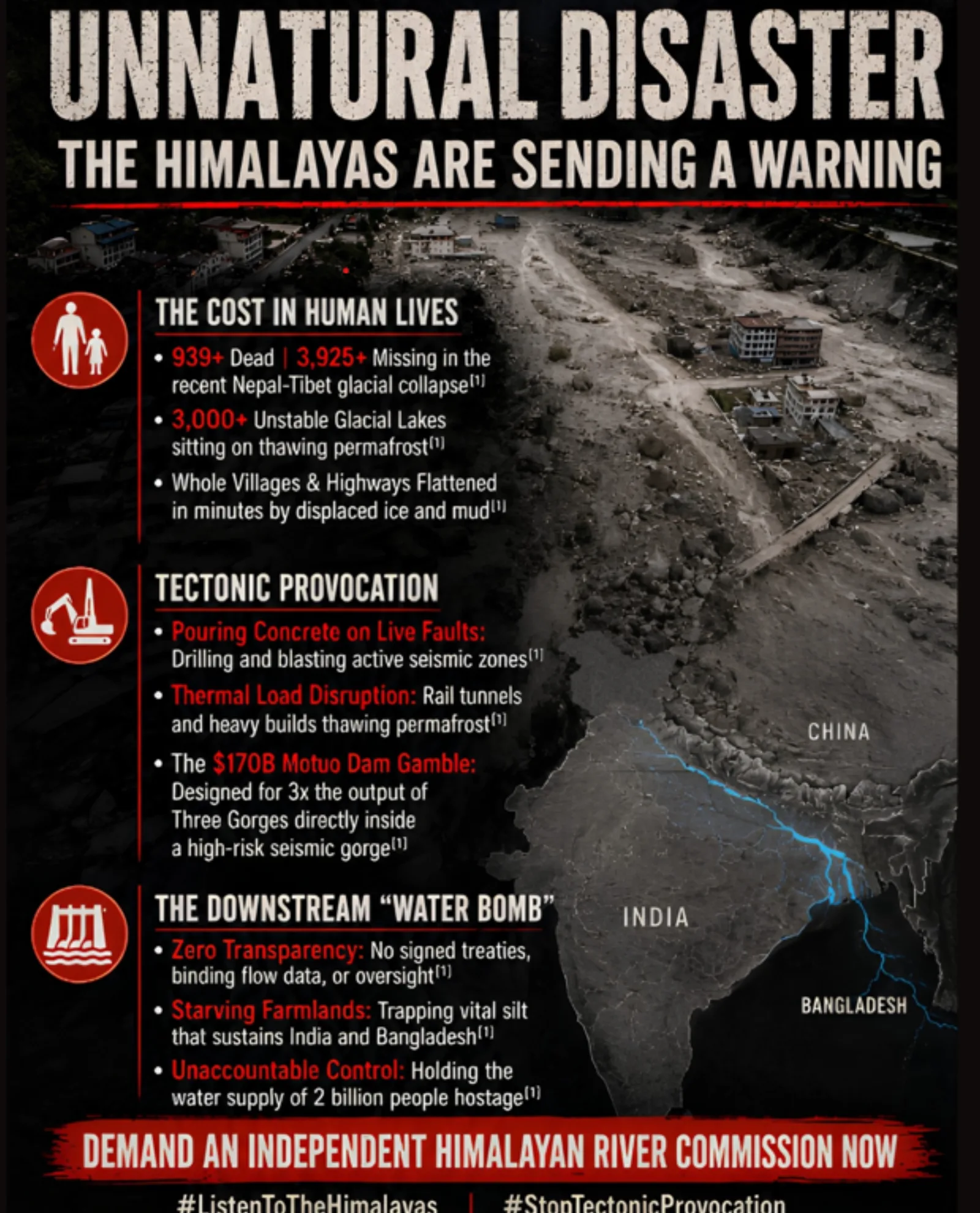
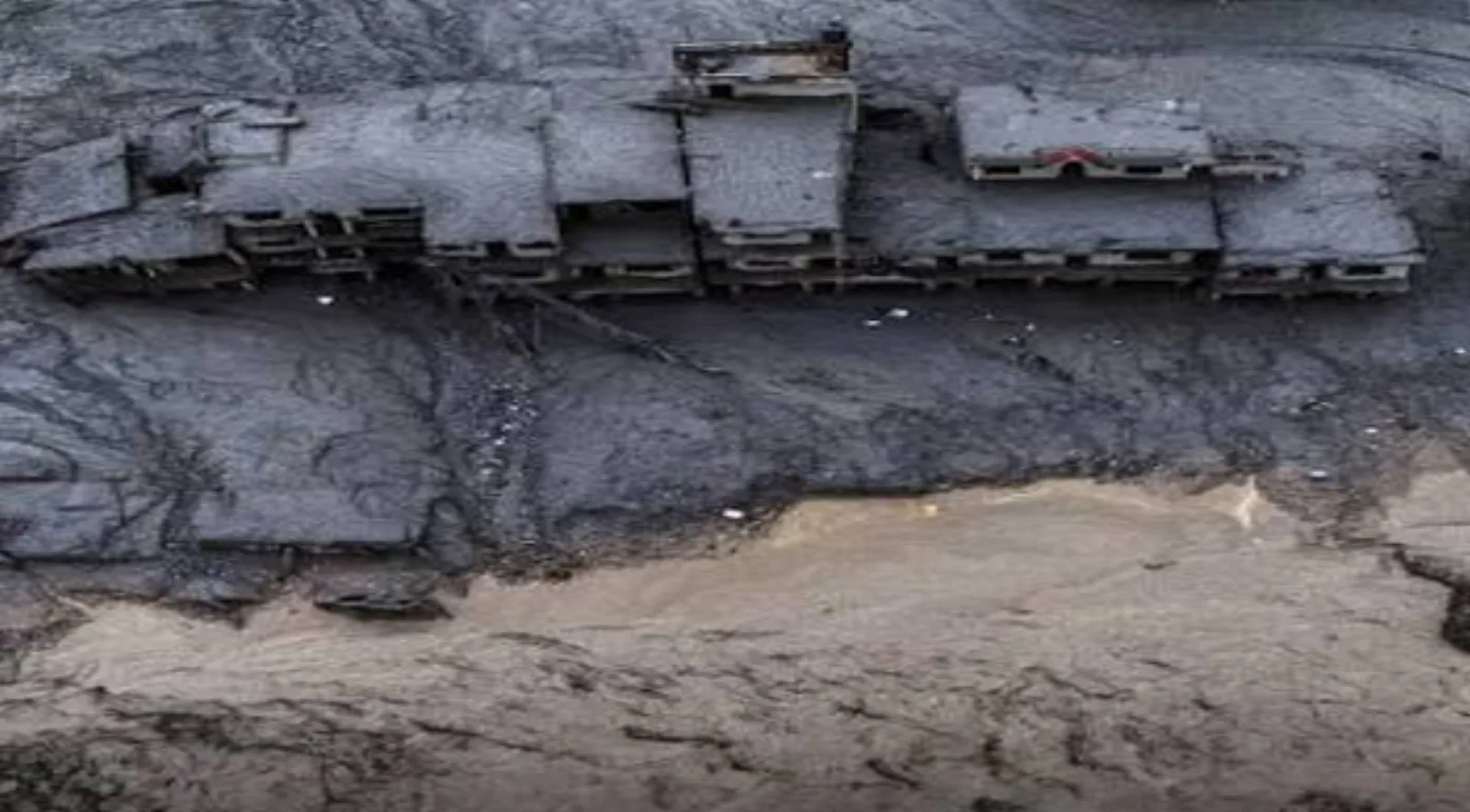
On the morning of August 26, 2026, a wall of ice, rock and mud tore down the Bhotekoshi and Trishuli valleys near the Nepal-China border. Within hours, entire settlements vanished beneath sludge. By the time this article was being written, the death toll had already climbed past 939, with more than 3925 people still unaccounted for, including hundreds of foreign trekkers. Scientists now believe a mass of the Langtang Lirung glacier broke away at altitude and slammed into the valley below, displacing enough water and debris to flatten bridges, highways and villages in minutes. This is not a freak accident. It is the latest entry in a rapidly growing ledger of Himalayan catastrophes, and it should mark the moment China stops treating the roof of Asia as a construction site.
The Himalayas are the youngest, most tectonically restless, and most geologically unstable mountain system on Earth. They are still rising by a few millimetres a year as the Indian plate grinds beneath Eurasia. Their slopes are laced with permafrost that has held rock and ice together for millennia. Their valleys contain more than three thousand glacial lakes, several dozen of which are classified as dangerously unstable. This is not terrain that forgives heavy engineering. It is terrain that punishes it.
Yet across the Tibetan Plateau, China has spent two decades pouring concrete into exactly this landscape at a pace and scale without precedent in mountain history. Roads blasted through live rock faces. Rail lines tunnelled through permafrost never meant to bear that kind of thermal load. Military infrastructure pushed into some of the highest, most seismically active ground on the planet. And now, the crown jewel of this build-out: the Motuo hydropower station on the Yarlung Tsangpo, a project reported to cost between one hundred and forty and one hundred and seventy billion dollars, designed to generate roughly three times the output of the Three Gorges Dam. Premier Li Qiang broke ground on it in Nyingchi in July last year, at the point where the river plunges nearly two thousand metres through the Great Bend before crossing into India as the Siang and then the Brahmaputra, and finally into Bangladesh as the Jamuna.
The geology of that gorge is about as unforgiving as it gets. It sits within one of the planet’s most active seismic zones, in terrain still being carved by a river that drops faster than almost any other on Earth. Building the largest hydropower station in human history within that gorge is not simply an engineering gamble. It is an act of tectonic provocation. Large reservoirs load the crust and have been linked to reservoir-induced seismicity elsewhere in the world. Tunnelling and blasting on this scale disturb slopes already primed to fail. Heavy construction generates heat, vibration, and altered drainage patterns, all of which interact with permafrost and glacial ice in ways that accelerate exactly the kind of collapse we just watched bury towns in Nepal. You cannot pour this much concrete into frozen, unstable ground and expect the ground to retain its old behaviour. It will not.
There is also the slower, quieter damage: the ecological cost that rarely makes headlines until it becomes irreversible. A dam of this magnitude traps the sediment that has built the Brahmaputra delta over thousands of years, the same sediment that keeps Assam's floodplains and Bangladesh's farmland fertile. Choke that flow, and you begin to starve one of the planet's most densely populated river basins of the silt it depends on for food security. Add deforestation, blasting, and new access roads that open remote slopes to further development, and you have not a single dam but a chain reaction across an entire watershed.
And then there is the part of this story that cannot be separated from geopolitics. China controls the headwaters of nearly every major river system in South and Southeast Asia. It has never signed a water-sharing treaty with India. It gives Delhi and Dhaka no binding commitment to share flow data, no seat at the table, and no independent oversight of what happens upstream. Arunachal Pradesh's chief minister has already warned that a dam of this scale could function as a water bomb, capable of drying the Siang in normal operation or unleashing a catastrophic surge if released deliberately during a crisis. Bangladesh formally asked Beijing for the project's environmental assessment and has yet to receive one it considers adequate. This is not paranoia. It is the plain and predictable consequence of one upstream power holding total, unaccountable control over the water supply of nearly two billion people downstream.
What makes this doubly dangerous is that China has built its entire posture on the claim that this is domestic infrastructure within its sovereign territory, therefore no one else's business. That argument might carry weight if rivers respected borders. They do not. A river is a shared organism, and international law has long recognised, however imperfectly, that upstream states have an obligation not to cause significant harm downstream. China has simply declined to be bound by that principle, in the Mekong, in the Indus system through its ties with Pakistan, and now in the Brahmaputra basin.
To be fair, not every scientist treats this as a settled catastrophe. Some researchers argue that a run-of-river design like Motuo will not hold back the volumes of water needed to weaponise flow as critics fear, and that China has a genuine incentive to avoid a disaster that would also damage its own territory and reputation. That caution is worth holding onto. But it does not address the seismic and ecological risks of construction at this scale in this terrain, nor does it touch the deeper problem, which is the total absence of transparency, shared data, or downstream consent.
This is why the response cannot be left to India and Bangladesh alone, nor to bilateral diplomacy, which Beijing has shown no interest in honouring. What the Himalayas need now is what the world built, however imperfectly, for the Mekong: an independent transboundary river commission with real monitoring authority, mandatory environmental impact disclosure, and a standing scientific body empowered to track glacial lakes, seismic risk, and construction activity across the entire plateau, not just on one side of a border. Every nation with a stake in Himalayan stability, from Nepal and Bhutan to India, Bangladesh, and the wider international scientific community, needs to treat this as a shared planetary risk rather than a private Chinese development matter.
The mountain has already spoken once this year, in the loudest possible language. Whether it needs to speak again before the world organises a real response is not a geological question. It is a political one, and right now the answer appears to be no.